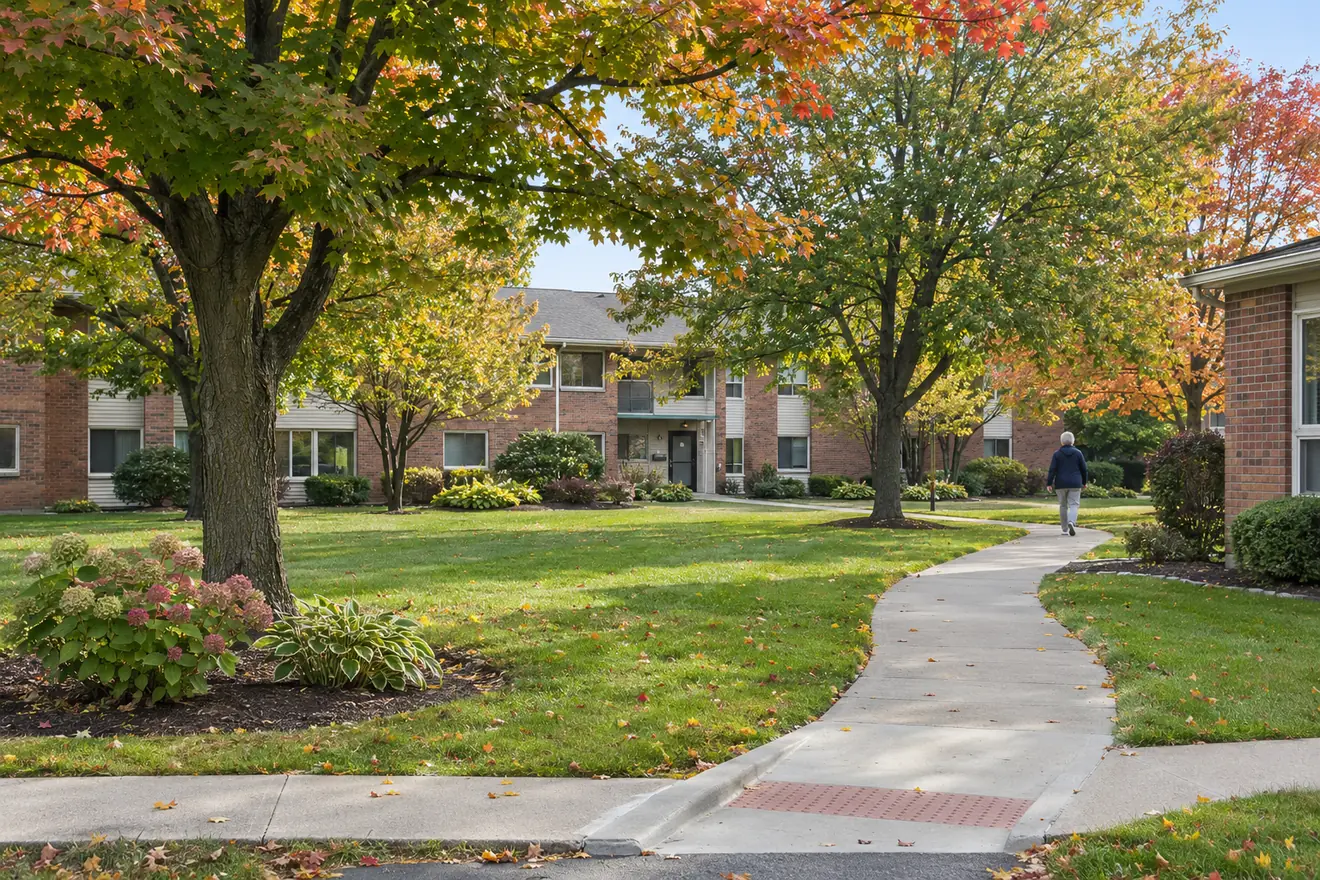
Senior apartments in Oakland County, Michigan fall into four groups: apartments with rental assistance (HUD Section 202, other HUD-assisted properties, public housing), apartments rented with a Housing Choice Voucher, income-restricted tax-credit apartments, and private rentals with an age rule. A fifth group, independent and assisted living, bundles housing with services. These choices work differently. Some assistance stays with a particular apartment; a voucher helps an eligible household rent an approved private apartment. An income limit alone does not mean rent will be based on income. Start by checking what program supports the housing, who decides eligibility, and how the resident’s payment is calculated.
This page explains the types. For the county-level overview, see the guide’s senior and affordable housing hub for Oakland County.
Types of senior housing in Oakland County at a glance
The word “senior” describes an age policy, but it does not explain the rent or services. “Affordable” also needs clarification: it may refer to rental assistance, an income-restricted program, or simply the way an apartment is advertised. Ask for the program name and written eligibility requirements before comparing options.
The table outlines the main categories. Cost, waiting lists, availability, and screening requirements vary by property and program. The property or housing agency decides whether an applicant qualifies under the applicable rules. This guide’s comparison of assisted housing programs explains the differences between assistance attached to an apartment and assistance used by a household.
| Type | Who runs it | Who can live there | How rent is set | How you get in |
|---|---|---|---|---|
| HUD Section 202 | Nonprofit sponsors under HUD program rules | Very low-income households meeting HUD’s elderly household requirement | Generally based on adjusted household income | Apply through the property’s designated application process |
| Other HUD-assisted multifamily housing | A property owner or manager under a HUD assistance agreement | Households meeting the property’s income and occupancy requirements | Under the rental assistance program’s rules | Ask the property how applications and waiting lists work |
| Public housing | A local public housing agency | Eligible low-income households, including older adults and people with disabilities | Under HUD’s tenant-payment rules | Apply through the responsible housing agency |
| Housing Choice Vouchers | A housing agency administers assistance; a private landlord rents the apartment | Households meeting agency and program eligibility rules | Based on income, agency limits, and the approved apartment’s rent | Apply through the administering housing agency |
| Tax-credit apartments | A property owner or manager | Households within applicable income limits; age restrictions may also apply | Restricted under the program, but not necessarily based on the resident’s income | Apply through the property |
| Private age-restricted rentals | A private owner or manager | Households meeting the age policy and rental screening requirements | Set by the owner without an income-based subsidy | Apply through the property |
| Private independent living or assisted living | A private operator | Residents meeting the setting’s admission requirements | Housing and service charges follow the private agreement | Ask the operator about admission, services, and charges |
Senior apartments with rental assistance
HUD Section 202 and other assisted apartments
HUD’s Section 202 program rules identifies eligible households as very low-income households with at least one member aged 62 or older. Nonprofit sponsors receive support to develop housing, and project rental assistance helps cover the difference between resident payments and operating costs. Residents generally pay rent based on adjusted income. Ask the property which assistance applies and how it determines the household’s payment. The guide’s page on HUD Section 202 housing in Michigan goes into more detail.
Other HUD-assisted multifamily housing may also have rental assistance attached to the property. These apartments are not automatically elderly-only housing. Check the occupancy requirements, income rules, and application process for each property. Assistance attached to an apartment generally does not become a voucher that the resident can take elsewhere.
Public housing
Public housing is owned and operated by local public housing agencies. Eligibility includes income, household status, citizenship or eligible immigration status, and references. The agency reviews the application and applies its waiting-list policies. According to HUD’s public housing page, the local agency decides eligibility based on annual gross income, whether the applicant qualifies as elderly, a person with a disability, or a family, and citizenship or eligible immigration status. HUD sets income limits relative to the area median income, with “lower income” at 80 percent and “very low-income” at 50 percent.
The same page explains that the resident’s Total Tenant Payment is the highest of 30 percent of monthly adjusted income, 10 percent of monthly income, welfare rent where it applies, or a minimum rent of $25 (an agency may set a higher minimum, up to $50), as of HUD’s published description. Adjusted income subtracts allowed deductions, which include $400 for an elderly household or a person with a disability and certain medical expenses. Ask whether the available housing serves older adults specifically or a broader range of eligible households. For a worked explanation of the calculation, see the guide’s page on the 30 percent rent rule and adjusted income.
Housing Choice Vouchers
With a Housing Choice Voucher, the household chooses an eligible private apartment, and assistance is paid to the landlord. The housing agency must approve the arrangement. A voucher does not mean every advertised apartment will qualify or that every rent will fit the agency’s rules. HUD’s voucher page for tenants says the household’s share is usually about 30 percent of adjusted monthly income and can be as high as 40 percent, with the housing agency’s subsidy paid directly to the landlord.
MSHDA administers vouchers in much of Michigan; local housing commissions also administer programs. Check which agency handles the area being considered, and read the guide’s page on the MSHDA Housing Choice Voucher program.
Income-restricted apartments and private rentals with age rules
Tax-credit apartments
Tax-credit apartments have income limits, but that does not make them equivalent to income-based rental assistance. Ask how rent is restricted and whether separate rental assistance applies. A household can meet an income ceiling yet still find the payment difficult to manage. Current limits for the county are covered in the guide’s page on senior housing income limits in Oakland County.
Private age-restricted apartments
Private age-restricted rentals may have no subsidy at all. The owner sets rent and screens applicants under the property’s requirements. Ask about income screening, deposits, utilities, and other required charges. Read the lease terms rather than assuming that a senior designation includes financial help.
Independent living and assisted living
Private independent living and assisted living are not themselves subsidized housing programs. Independent living may combine housing with optional or included services. Assisted living includes support with daily needs. Ask what care is available, what is included in the agreement, and what happens if needs change. Housing assistance and payment for care are separate questions. For help sorting out services for older adults in the county, see the guide’s page on the Area Agency on Aging in Oakland County.
Which type of senior apartment fits which situation?
- Low fixed income and a need for rent tied to income: Section 202, other HUD-assisted properties, public housing, or a voucher. These are the types where rent is typically calculated from adjusted income, and waiting lists are common.
- Income under a ceiling, but not very low: tax-credit apartments may fit, though the rent is a set restricted amount rather than a share of income.
- Steady income and a wish to live among people of a similar age: private age-restricted rentals, where the owner sets the rent and screens applicants.
- Need for meals, housekeeping, or help with daily tasks: independent or assisted living, priced under a private agreement.
- Need to move soon: subsidized waiting lists can be long, so applying to several lists while also looking at private options is common. HUD’s voucher page notes that, because of high demand, applicants may need to apply to several housing agency waitlists.
What age restrictions mean
Age rules differ by program and property. HUD’s Section 202 household rule requires a member aged 62 or older; that is different from the federal Fair Housing Act’s older-persons exemption for housing where all residents are 62 or older.
Under the federal Fair Housing Act’s older-persons exemption, 55-and-older housing generally must have at least one resident aged 55 or older in at least 80 percent of occupied units and follow published age-verification policies. That rule does not guarantee admission for a younger household member. Ask for the property’s written occupancy policy. Michigan’s civil rights law also addresses housing discrimination and exceptions for senior housing; the Michigan Department of Civil Rights is an official source for questions. Residents with disabilities may also request changes to rules or buildings; the guide explains this in its page on reasonable accommodations and fair housing for seniors.
How to look for senior apartments and check eligibility
Use HUD’s resource locator to identify possible assisted housing, then confirm program details with the property or responsible agency. HUD’s Michigan page provides another official starting point. A directory listing does not establish current availability, eligibility, or acceptance of applications.
Lists open and close, and each administrator sets its application procedures. Ask how to keep contact information current and respond to requests; HUD warns that voucher applicants who do not keep the agency updated on address, phone, and household changes may be removed from the list. The waiting-list guide explains these steps, and how to apply for affordable senior housing walks through the application process. Before sending documents or money, review the rental scam warning signs and confirm the recipient through an established official source. Once a place is secured, the guide’s page on downsizing and moving to a senior apartment covers the move itself.
What to check
- Which program, if any, supports the apartment, and who makes the eligibility decision?
- What age, income, household, and screening requirements apply?
- Is rent based on household income, restricted by a program, or set privately?
- Which utilities, services, deposits, and other charges are separate?
- Where are applications accepted, and how are waiting-list updates handled?
- What written lease terms, service agreements, and accommodation procedures should be reviewed?
Frequently Asked Questions
Are all senior apartments in Oakland County subsidized?
No. Some have rental assistance, some have income restrictions without income-based rent, and others are private rentals with age requirements. A senior designation does not establish financial assistance. Ask the property for the program name, eligibility rules, and an explanation of how rent is determined.
What is the difference between Section 202 housing and a voucher?
HUD’s Section 202 assistance is connected to housing serving eligible older households. A Housing Choice Voucher helps an eligible household rent an approved private apartment. The application process differs, and assistance connected to a property generally cannot be taken to another apartment as a voucher.
Does meeting an income limit mean I will get an apartment?
No. Income is only part of the review. The property or housing agency applies the program’s other eligibility and screening requirements, and availability depends on its application and waiting-list procedures. Ask which income limits apply and what documents are needed before assuming the household qualifies.
What is an age-restricted apartment?
It is a rental where the owner limits residents by age, commonly 55 or older or 62 or older. Under the federal older-persons exemption, 55-and-older housing generally needs at least one resident aged 55 or older in at least 80 percent of occupied units. An age restriction does not by itself mean the rent is subsidized.
How much rent will I pay in subsidized senior housing?
It depends on the program. In public housing, HUD’s published formula takes the highest of 30 percent of monthly adjusted income, 10 percent of monthly income, welfare rent, or a minimum rent. With a voucher, the household share is usually about 30 percent of adjusted income and can reach 40 percent. Tax-credit and private rents are not set this way.
Can a younger spouse live in senior housing?
It depends on the program and the property’s occupancy policy. HUD’s Section 202 program rules requires at least one household member aged 62 or older. Other age-restricted housing follows different rules. Ask the property to explain in writing how its policy applies to everyone in the household.
How do I find out whether a property is taking applications?
Check directly with the property or responsible housing agency through a verified source. Waiting lists open and close, and directory information may not reflect current procedures. Ask where applications are accepted, whether a separate list applies, and how applicants must keep their information current.