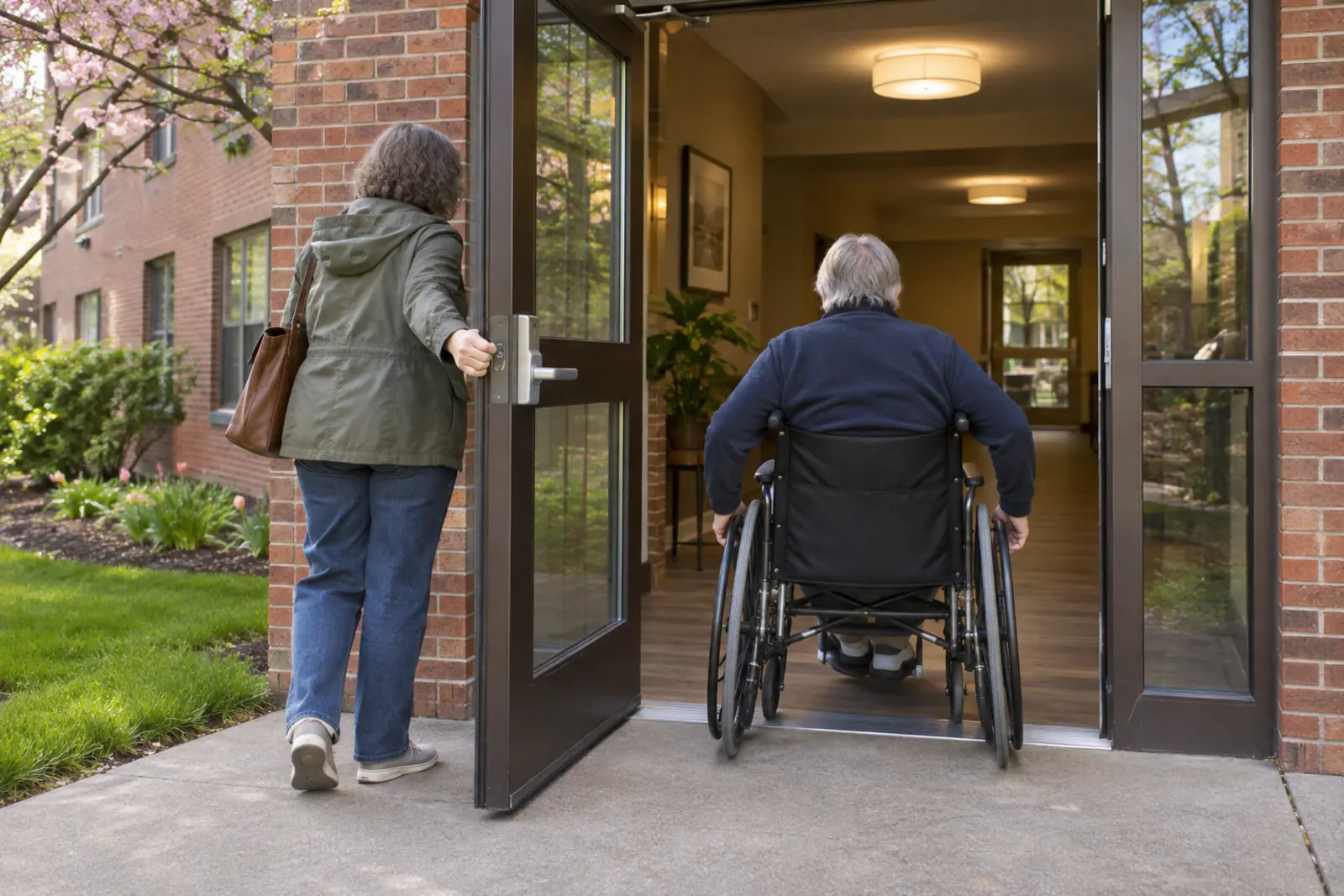
A reasonable accommodation in senior housing is a change in a rule, policy, practice or service that gives a person with a disability an equal opportunity to use and enjoy their home. An older adult may need an assigned parking space, help with application forms or an exception to a no-pets rule for an assistance animal. The request must relate to a disability; age alone does not establish that need. Under the Fair Housing Act the housing provider generally pays for an accommodation, while the tenant generally pays for a physical modification such as grab bars. This guide explains how to ask, what a provider may request in return and where to raise a fair housing concern in Michigan.
What a reasonable accommodation can address
A standard procedure can create a barrier for someone with a disability even when everyone receives the same instructions. An accommodation changes how that procedure applies. Explain the barrier and the change that would help. A request does not need legal language, but the provider needs enough information to understand the connection between the disability and the requested change.
The Fair Housing Act protects people with a physical or mental impairment that substantially limits one or more major life activities, such as walking, seeing, hearing or caring for oneself. According to the HUD and Department of Justice joint statement on reasonable accommodations, there must also be an identifiable relationship between the requested change and the person’s disability. A request that has no connection to a disability can be denied.
Examples of changes to request
Depending on the disability-related need, a request might involve an assigned parking space near the entrance, a service or assistance animal despite a no-pets rule, help completing forms, or a different way to pay rent. A ground-floor unit or transfer may also address a disability-related barrier. These are examples for consideration, not promises that a particular request will be approved.
HUD and the Department of Justice give several examples of their own. A resident with a mobility impairment may need an assigned accessible space even though the provider normally leaves parking unassigned. A tenant whose disability makes it hard to leave the unit may ask to have a friend mail the rent instead of paying in person. A tenant who is deaf may ask to keep an assistance dog despite a no-pets policy. Providers may not charge an extra fee for accessible parking or require a fee or deposit as a condition of granting an accommodation.
An applicant using a voucher might request additional search time because a disability makes the search more difficult. Explain the need to the housing agency and ask about its accommodation process; the guide to the MSHDA Housing Choice Voucher program in Michigan explains how the program works. A request for a ground-floor unit or a transfer can interact with a waiting list, which is covered in the guide to how senior housing waiting lists work. For help preparing ordinary application materials, see the general application process for affordable senior housing. Keep accommodation correspondence with the application records.
Accommodations and physical modifications
An accommodation usually changes a rule, practice or service. A reasonable modification changes the physical space, such as installing grab bars or a ramp. Describing the barrier first can help clarify whether a policy change, physical change or combination would address it. A request for a modification may be made at any time during a tenancy, and a provider may not deny or restrict access to housing because an applicant asks for one.
Reasonable modification of an apartment for a disability
The HUD and Department of Justice joint statement on reasonable modifications lists changes that are typically reasonable: widening doorways, installing grab bars in bathrooms, lowering kitchen cabinets, adding a ramp at a primary entrance, and altering a walkway to reach a common area. Modifications are not limited to the inside of a unit and can include common areas such as a laundry room entrance. The provider must permit the change; under the Fair Housing Act the tenant pays for it. Parking is the notable exception, because courts treat a parking request as an accommodation that the provider must provide.
Who pays for physical changes
Responsibility for paying for physical changes depends on the housing and the applicable requirements. Federally assisted providers have greater obligations under Section 504 of the Rehabilitation Act. HUD and the Department of Justice explain that in housing receiving federal financial assistance, structural changes needed by a resident with a disability are treated as reasonable accommodations. The provider must pay for them unless doing so would be an undue financial and administrative burden, a fundamental alteration of the program, or the need can be met by other means. Housing programs such as HUD Section 202 housing for the elderly in Michigan are federally assisted, so ask the provider which rules apply and how payment responsibility will be determined before arranging work or spending money.
Covered multifamily buildings first occupied after March 13, 1991 must meet design and construction requirements, such as wall reinforcements for grab bars. If a needed feature should already have existed under those requirements, the provider may be responsible for it. In the example given by HUD and the Department of Justice, the builder pays for wall reinforcements in a covered building, while the tenant pays for the grab bars themselves.
What a provider may and may not require for a modification
- A provider may ask for a description of the proposed work, may require any building permits needed and may require that the work be done in a workmanlike manner.
- A provider may not insist on a particular contractor, require special liability insurance or raise the security deposit because of the modification.
- In a rental, the provider may ask the tenant to restore the interior to its prior condition when that is reasonable, except for ordinary wear and tear. Exterior and common-area changes, such as a ramp, do not have to be restored.
- In the HUD and Department of Justice examples, it is reasonable to ask for grab bars to be removed, but not for hidden wall reinforcements to be removed or widened doorways to be narrowed again.
- Only in limited circumstances may a provider negotiate an interest-bearing escrow account to cover restoration, and the amount cannot exceed the cost of restoring the modification.
How to make a request
HUD and Department of Justice guidance says an accommodation may be requested orally or in writing. Writing is usually helpful because it creates a record of the request and the provider’s response. A family member or another person may make the request on the resident’s behalf, and the request does not need to mention the Fair Housing Act or the words “reasonable accommodation.” Keep a copy of anything submitted, along with notes about conversations and any supporting verification.
- Identify the rule, procedure or barrier that is causing difficulty.
- Describe the change being requested in concrete terms.
- State that the change is needed because of a disability and explain the connection.
- Ask where to send supporting information and how the provider will communicate its decision.
A short request can be enough to begin the discussion. For illustration, a household might explain that a disability limits walking distance and request an assigned parking space near the entrance. The useful information is how the change addresses the barrier. A detailed account of the person’s medical history is unnecessary.
A provider may have its own form, but HUD and the Department of Justice say it must still consider a request made orally or without that form. The provider is also expected to respond promptly, and an undue delay may be treated as a failure to grant the accommodation.
What the provider may ask for
If the disability or the need for the accommodation is not obvious, the provider may request reliable verification of the disability-related need. It should not request medical records or details of the diagnosis. Ask what information is missing if a provider says the request needs more support.
According to the HUD and Department of Justice guidance, a person under 65 who receives Supplemental Security Income or Social Security Disability Insurance benefits, or a credible statement from the individual, can usually establish the disability. A doctor, a peer support group, a non-medical service agency or another reliable third party who knows the person may also provide verification. If the disability and the need are both obvious, such as a resident who uses a walker asking for a nearby parking space, the provider may not ask for further information. Any information provided must be kept confidential.
| Situation | What to ask for | What the provider may ask in return |
|---|---|---|
| Walking from parking creates a disability-related barrier. | An assigned space near the entrance. | Reliable verification of the need if it is not obvious. |
| A disability makes completing paperwork difficult. | Help with forms or a change in the application procedure. | An explanation of the assistance needed and verification if the connection is not obvious. |
| An assistance animal is needed despite a no-pets rule. | An exception related to the disability. | Reliable verification of the disability-related need when it is not obvious. |
| A disability makes a voucher search more difficult. | An extension of search time through the housing agency. | An explanation of the connection and supporting verification if needed. |
If the provider denies the request
A provider may deny a request that would impose an undue financial and administrative burden or fundamentally alter its operations. The HUD and Department of Justice guidance says the provider should then discuss alternatives. A denial of the requested approach does not necessarily end the discussion about removing the barrier.
The guidance lists factors for deciding whether a burden is undue: the cost of the accommodation, the provider’s financial resources, the benefit to the requester and whether a cheaper alternative would work equally well. It also says a requester is not obligated to accept an alternative the provider suggests if the alternative will not meet the disability-related need and the preferred request is reasonable. A failure to reach agreement is treated as a decision not to grant the request.
Ask for the reason in writing and consider whether another change would meet the same disability-related need. Keep the denial, the original request and any alternatives discussed. These records can help a housing counselor or legal aid organization understand what happened without requiring the applicant to reconstruct every conversation.
Age rules and fair housing protections
Michigan’s Elliott-Larsen Civil Rights Act lists age among the grounds on which discrimination in real estate transactions is barred, and its housing section also bars landlords with five or more rental units from discriminating based on a tenant’s source of income, such as a voucher. Disability in housing is addressed separately, in Michigan’s Persons with Disabilities Civil Rights Act. That law bars refusing reasonable modifications, at the tenant’s expense, and refusing reasonable accommodations in rules, policies, practices or services. Federal fair housing law also permits qualifying housing for older persons to restrict occupancy by age when it meets the applicable requirements.
An age restriction and a disability accommodation are separate questions. Ask the provider to explain its occupancy rules and how they apply to the household. A senior housing designation does not answer whether a requested disability accommodation is reasonable. The federal law also has exceptions, including owner-occupied buildings with four or fewer units, so not every landlord is covered. For comparison of program types, see the guide to public housing, vouchers and Section 202. Verify age restrictions and Michigan protections with the Michigan Department of Civil Rights.
Where to raise a fair housing concern
HUD accepts housing discrimination complaints through its online fair housing complaint page. HUD’s intake line is 1-800-669-9777, and a complaint can also be mailed on HUD form 903.1. The HUD and Department of Justice guidance says a complaint to HUD may be filed within one year of the alleged denial, or a lawsuit may be filed in federal district court within two years; verify the current filing requirements with HUD promptly. HUD investigates a complaint at no cost to the complainant, and retaliation for filing a complaint is illegal.
A complaint should include your name and address, the name and address of the person or organization you are complaining about, the address of the housing involved, a short description of what happened and the dates. The Michigan Department of Civil Rights is another official source for Michigan housing discrimination concerns, and its filing time limits should be confirmed with the department directly.
This page provides reference information, not legal advice. HUD and the Michigan Department of Civil Rights explain their complaint processes and evaluate matters within their authority. Legal aid organizations may help assess a denial or discrimination concern. The guide to Area Agency on Aging resources and help for older adults explains where to seek resource connections and referrals.
What to check
- Which rule or barrier needs to change, and how it relates to a disability.
- Whether the request involves a policy change, a physical modification or both.
- Whether the housing is federally assisted, which affects who pays for physical changes.
- Where the provider accepts requests and supporting verification.
- Whether copies of the request, responses and conversation notes are complete.
- Which alternatives could meet the need if the original request is denied.
- Current complaint requirements with HUD or the Michigan Department of Civil Rights.
Frequently Asked Questions
Can I request a housing accommodation without filling out a special form?
Yes. HUD and Department of Justice guidance allows requests orally or in writing. Writing is usually helpful because it creates a record. Explain the change needed and its connection to a disability, and keep a copy of the request and any response.
Can a landlord ask for my diagnosis or medical records?
A provider may seek reliable verification of the disability-related need when the disability or need is not obvious. It should not ask for medical records or details of the diagnosis. Ask the provider to identify the information it needs to understand the connection.
Does a no-pets rule prevent me from having an assistance animal?
A disability-related request for a service or assistance animal can involve an exception to a no-pets rule. Approval depends on the request and applicable requirements. If the disability-related need is not obvious, the provider may request reliable verification of that need. The provider may not charge a fee or deposit as a condition of granting the exception.
Who pays for grab bars or a ramp in rental housing?
Payment responsibility depends on the housing and applicable requirements. Under the Fair Housing Act the tenant generally pays for a modification, while the provider must permit it. Federally assisted providers have greater obligations under Section 504 of the Rehabilitation Act and must generally pay for needed structural changes unless it is an undue burden. Ask which rules apply and how payment will be handled before arranging work.
Do I have to remove a ramp or grab bars when I move out?
Not always. The HUD and Department of Justice statement says a provider may require restoration only of interior changes, only where it is reasonable and only if the provider asks. Exterior and common-area changes such as a ramp do not have to be restored. A tenant is not responsible for ordinary wear and tear.
Can someone else make the request for me?
Yes. HUD and Department of Justice guidance says a family member or another person acting on the resident’s behalf may make the request. The request does not have to use legal terms. It must be clear enough that a reasonable person would understand it as a request for a change because of a disability.
What can I do if my accommodation request is denied?
Ask for the reason in writing and discuss alternatives that could address the disability-related barrier. Keep the request and response. HUD and the Michigan Department of Civil Rights provide complaint processes, and legal aid organizations may help assess the situation.
How long do I have to file a fair housing complaint?
HUD and Department of Justice guidance says a complaint to HUD may be filed within one year of the alleged denial, and a federal lawsuit within two years. Time limits for a Michigan Department of Civil Rights complaint should be confirmed with that department. Filing promptly protects the record and the right to a remedy.